



Yes, you can be both, at the same time, and no, if you do it ethically (and I do!), an agent can be an editor too. A lot of people wonder about the two different roles I’m in and how I keep them separated. So, I thought I’d go over it here to help understand what I do in each role—and what I don’t do—as well as how they overlap and why I do what I do. Consider this a “month in the life of” post.
First and foremost, although I’m an “editorial-minded” agent, I never charge for editing services as an agent. It’s an important point to cover. Agents never take money directly from their literary clients—ever. The only way an agent gets paid for the work they do on a client’s manuscript or proposal submission is if the project sells to a publisher; the money comes directly from the publisher, not the author. So, it’s imperative to mention that I cannot represent a manuscript for which I’ve been paid to work on. You can choose to work with me as your editor or you can choose to take your chances on querying me (keeping in mind that agents typically only offer on 1-2% of the queries they receive). I work hard to keep these two roles separate, even though there’s some overlap, given the fact that they’re both within the publishing industry. I’m a rule-follower; ethics and morals matter to me, so I take both roles very seriously. And I honestly love both my roles! How could I not? They’re both about books! If I could tell little me that one day, I’d get to work on people’s books and help make their dreams come true, I can only imagine the look of wonder and excitement in my eyes. 🥹
Editing
I own and operate Foxx Editorial, and I’ve been doing that before I became an agent. I’m trained through SFU in British Columbia and am associated (a member of) two professional editorial organizations. I offer a range of full manuscript and other services for writers:
Developmental edits
Manuscript assessments
Stylistic (line) edits
Copyedits
Proofreading*
Nonfiction proposal assistance
guidebook
assessment
assessment + edits
transferring your Word doc into a beautiful, custom PDF that pops and wows
Query and synopsis critiques
Opening pages critiques
Courses (more coming!)
*I offer proofreading only in certain circumstances
I work with authors 1:1 to improve and elevate their fully drafted fiction manuscripts and creative nonfiction proposals, preparing them for querying or self-publication. When someone reaches out to me, we discuss their needs and I provide a complimentary sample edit to those who are seriously considering booking with me after I go over my services, rates, and expected timeline (I’m usually booked 5-7 months in advance). This gives the client a sense of my editorial and communication style, and it helps me gauge the scope of work involved and provide them with a more accurate recommendation and quote.
The reason I say I provide a complimentary sample edit “to those who are seriously considering booking with me” is that, sometimes, people are just looking for free work. No one should be expected to give away their expertise for free in this way, and no one should think it’s ok to take advantage of an editor in this (or any) way. I’m not being paid for the complimentary edit—I’m providing it hoping it will pay for itself when the client books with me. This is something that helps us both decide whether we’re a good fit—and sometimes? We’re not, and that’s ok; it is, after all, only a few pages, and I know it’s still at least minimally helpful to the author. Sometimes, the author comes back to me when they’re ready because they were happy with my sample edit but they decided they needed to do some more work on their manuscript first. It’s great when this happens! But it doesn’t always happen—and that’s ok. A client must go with the editor they jive with the most and who’s offering the service that best fits their manuscript’s needs.
What I don’t do:
Book coaching
Ghostwriting
Assist in finding a literary agent or publisher
Publish your book
Formatting and typesetting
Undercut my peers
That last one is important, and I’ll get to that in a moment.
Here’s some unsolicited advice about finding and working with an editor: An editor is a contractor; you contract services with them based on your needs and their expertise. You’re paying them for their time and that expertise. I’ve had folks ask if I’ll accept a lower amount for the same service offered, and trust me—I get you. It’s disposable income and it’s hard to part with, especially in these dark times. But my time is valuable, just as yours is. And this is your book baby. My guess is that, if you’re looking for an editor, then you’re expecting that it’ll come at a cost, so you’re serious about this manuscript. My rates are within the industry standard range, and I bring the additional expertise and insights of a literary agent. If your boss came to you and said, “Hey, we’re going to cut your pay, but we expect the same amount of work to be done,” that would seem unfair, wouldn’t it?
Let’s put it this way: if your toilet was overflowing and it just.won’t.stop, you would call the plumber. You wouldn’t ask the plumber to accept a lower fee to fix your toilet, right? The plumber is being contracted for services you’ve determined you need, and they have an established rate (and likely a premium for emergencies). They’re doing a job that you’re unable to do, but geez, are you ever glad they’re there to help, because yikes! What about asking the person working on your car’s brakes to pay a lesser amount? 😬
It’s the same thing with an editor. Publishing a book the right way is a costly venture—there’s no way around that. If you don’t have enough to hire an editor, don’t fret! My suggestion is to save up for it and book the person you want to book, who you know will “get” your story and help you elevate it. The entire process takes time—writing, editing, and publishing. Don’t rush, and don’t settle for something less than what you and your manuscript deserve. (The old adage rings true: you get what you pay for.)
I always discuss options with my clients, though; perhaps there’s another service that can still be helpful (such as an assessment) and that doesn’t cost as much. I mentioned that I don’t undercut my peers in that list above; that’s another reason why I don’t offer lower rates. It wouldn’t be fair to them. But I do have options where a client can pay a lesser rate for a different service, if it’s suitable for them and their project. (Not the same, I imagine, for the plumber and car/brake mechanic, though—gah!)

(FTR I was going to put an image of an overflowing toilet here but I just couldn’t do it—you’re welcome! Instead, enjoy these lovely wildflowers that I’m sure smell delightful!)
Agenting
When it comes to being an agent, yes, my editorial mindset carries over into my agenting role. I can’t help it! It’s how my brain operates. Not only that, but I’m also vouching for the manuscripts and proposals I’m sending out, and we at The Rights Factory have a great reputation to uphold. Editors expect the best from us, so that’s what we send them. And we help ensure our clients’ manuscripts and proposals are the best. The difference is that I’m working with clients who I’m representing, and I’m helping to ensure their manuscripts are in the best possible shape and that they’ll meet industry expectations before we go out on submission to editors at presses/imprints. By the time I see that manuscript, it’s already been polished to the best of my client’s ability. It may still need some work, but we have an established relationship and I know and trust their writing skills. It’s a project I believe in, and if I can see a way to make it better, it will only be better for both of us in the long run. (Hopefully! There are still never any guarantees.)
But for a querying author, even if I love the concept, I have to remind myself that if there’s a lot of work to be done before it goes on submission, that’s an awful lot of time and effort on my part that I may not ever be paid for if I can’t sell it, so it makes me think twice about offering representation. For me (and I imagine most, if not all agents), it has to be something that’s so well written and that I believe in so much that I’m willing to take the risk on it. And a lot of things come into play here: the status of the market, the status of that particular genre in the market, what editors are currently looking for, what I see happening in recent acquisitions, what I hear from readers on tastes, what my colleagues’ thoughts and experiences are…let alone the quality of the story and writing. There’s so much to consider when offering representation. This is why it’s so imperative to ensure your manuscript is unputdownable, that it has a super strong hook, characters to fall in love with, compelling plot points, and spec👏🏻tac👏🏻u👏🏻lar👏🏻 writing to pull it all together. The closer to perfection it is, the more likely an agent will fall in love with it and offer representation. The less work that has to be done with it at the querying stage, the better—because it helps agents see the potential in both you and your story and lets them feel confident in taking that risk on you and your project.
What I don’t do as an agent:
offer on all the manuscripts (sad, but true!)
help a querying author complete their manuscript
request that a querying author book me as an editor and then I’ll rep them (never ever!)
offer feedback or edits on queries/sample chapters (I have, and I do, but it’s rare—there’s just not enough time)
publish the book
guarantee the book will be published
publicity management
rewrite, ghostwrite, or substantially edit clients’ manuscripts
replace the job of an editor before the client’s manuscript comes to me
What I do as an agent:
read queries
read manuscripts
read comps
offer on projects that I connect with and get excited about
having “the call” with potential clients
signing them
all the administrative stuff that follows, including signing the agency contract, gathering an author photo and bio, posting about our new partnership on socials, adding them to our agency website as well as my own, and sometimes this process involves a lot of back-and-forth and time
work with clients on the various stages of their manuscripts
research publishers/presses/imprints and their respective editors
get to know editors via meetings (phone, email, virtual meeting, in-person when possible)
build submissions lists, paying close attention to who’s looking for what and who matches what we’re submitting
help build proposals (this most often happens when I reach out to someone who hasn’t queried me; they may not have a proposal ready but they’re someone I want to work with)
help fine-tune manuscripts with developmental/structural notes, copyediting, etc.
send projects out on submission (including interacting and following up with editors, etc.)
handle offers on projects
handle contract negotiations
attend editorial, production, and marketing and publicity meetings with the acquiring editor and their team; this can increase in the weeks leading to and during launch
attend regular agent meetings with my colleagues
attend pitch events
attend conferences
read book-related and publishing-related news
put together newsletters like this one to help inform authors so they can make educated decisions and learn things they may not have already known
interact with the writing community and be an all-around good literary citizen
Phew! As you can see, the job of either a literary agent or an editor is immense and time-consuming—and I’m sure I’ve forgotten something here somewhere too. Combined? Even more so. But because agents have so much work to do and don’t earn an income for all that time and effort until we get a client list built up and start getting some deals under our belt, and unless we have someone who can pull all the financial weight at home (lucky ducky!), most of us have another job—at least for the first several years of agenting.
Mine is editing.
And I love my work! I truly love what I do in both roles. I’m super proud of the editorial business I’ve built from the ground up and of what I’m building as an agent. But it’s…a lot!
Add to that the administrative work for both roles: client meetings and calls; countless emails with clients, editors, colleagues, potential clients, etc.; keeping my schedule up to date (and panicking when I have to play Tetris with it when unexpected things come up!); travel when heading into the city for a work-related meeting/event or conference; social media upkeep for both accounts (which is exhausting, by the way); and more.
And this is why it’s important to only work on projects that really excite me and with clients I jive well with. It doesn’t mean your story isn’t great—it just means it’s not for me. And if I’m not 110% in love with it as an agent, I won’t be able to sell it as well as someone who is in love with it, and you deserve that! At some point, I need to consider my own sanity and time to rejuvenate. Time with my family is precious (and there’s never enough of it). Both my roles take up so much of my time that I have learned to be super selective about what I choose to take on in either capacity (especially in agenting, though).
But it’s all for the love of books. Stories. Keeping storytelling alive, helping to give wings to stories. Giving people a voice. Helping to provide enjoyment and entertainment in the simple act of sitting in a comfy spot and reading, entering someone else’s world, meeting characters you care about, going on an adventure (!), learning empathy, learning anything.
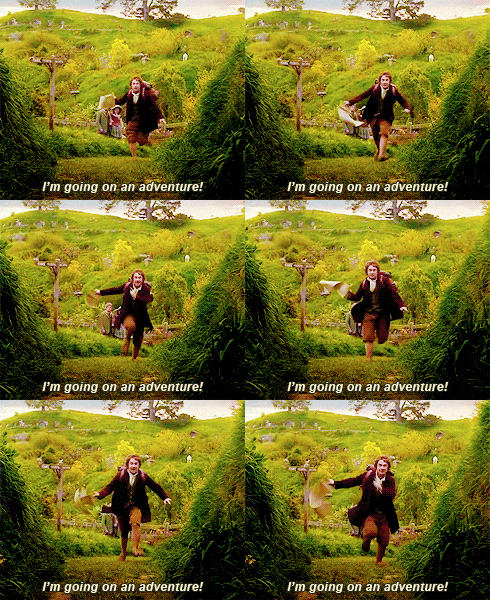
Stories matter. And I do what I can to help you get them out into the world!
Do you have questions about my agenting and/or editing roles? Do you find informative posts like this helpful? Leave a comment and let me know!
Until next time, happy drafting!
First of all, phew for you. Do you sleep? That's a big workload. This certainly helps give perspective when you consider all agents likely do similar for their clients. And there are way more writers than agents. I admire that you don't let your two worlds cross over. Do you also write?